The disruptive innovation of AI and its uses in enrollment management
With artificial intelligence quickly attracting public attention and gaining steam in higher education, how can the burgeoning tools be harnessed to benefit strategic enrollment management at the University of Wisconsin–Madison?
It requires clear guidelines, adaptability in a rapidly changing landscape, and human interventions to identify good AI-generated content from bad, Associate Vice Provost for Enrollment Management Scott Owczarek says.
Owczarek shared his observations on the current and future uses of generative AI in the Division of Enrollment Management (DEM) with roughly two dozen staff and board members from the nonprofit Educational Credential Evaluators on April 25. The presentation highlighted ways AI tools are already being utilized in higher education, including in credit evaluation, data analysis, and communications.
Within DEM, the Office of Student Financial Aid (OSFA) has rolled out an AI chatbot on its website to answer student questions and the Office of the Registrar (RO) uses it for everything from training and brainstorming to error troubleshooting and meeting facilitation.
“Generative AI tools have already proven themselves useful in streamlining repetitive tasks, and they offer incredible promise for the future,” Owczarek says. “Within the Division of Enrollment Management, we’re exploring multiple ways to responsibly harness these tools’ capabilities to better serve our campus and remain at the forefront of innovation.”
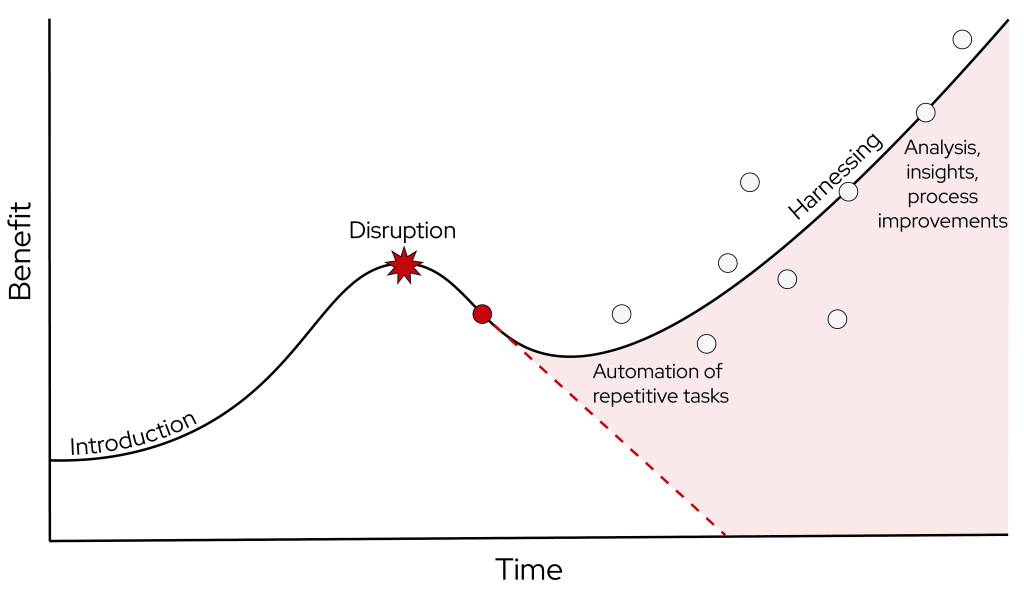
In the future, generative AI could be used to help refine business practices, automate repetitive tasks, and increase efficiency.
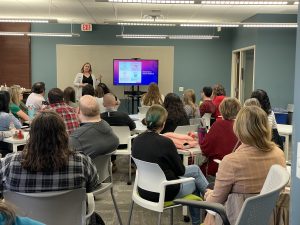 Channpraseut, the RO’s director for student enterprise applications, also shared various references those interested in experimenting with generative AI can use to further their understanding of how the tools work. Microsoft Copilot, which is now available to UW–Madison students, faculty, and staff, offers examples of quality prompts for tasks ranging from summarizing a document to catching up on emails and chats. The university has also made available recordings of a 2023 webinar series dedicated to exploring AI in depth.
Resources such as those and the policies governing AI use on campus help provide clear guidelines that minimize risk and keep data protected, a critical consideration since university users have access to personally identifiable, sensitive, and proprietary information. Any sensitive information, including that covered by the Family Educational Rights and Privacy Act of 1974 (FERPA), is off-limits for use with AI tools.
Institutions like UW–Madison have given substantial forethought to the practical, ethical, and moral considerations posed by AI, and that work has paid off. A March report from the Stevens Institute of Technology found that while Americans have concerns about how AI is used and regulated, a majority – 52% – trust higher education institutions to “get it right” and use the tools responsibly.
The university has also made AI a priority; it is the main focus of the new Wisconsin Research, Innovation and Scholarly Excellence (RISE) Initiative announced in February.
Ultimately, Owczarek says, generative AI is a disruptive innovation to which society is still learning how to adapt, but like the internet and the smartphone, it can be harnessed to make life easier and synthesize information in new and faster ways.
“It won’t be AI replacing human expertise,” he says, “but rather people who learn to leverage AI replacing those who don’t.”
Learning by doing
The myriad tools available on the market can be overwhelming, but many popular personal and work-related services and devices already incorporate AI – and users may not even realize it at first. Everything from virtual assistants like Alexa to recommendation systems on streaming platforms and fraud detection tools at banks utilize AI models. To help the RO team conceptualize how AI could benefit their daily work, during the DEM All-Team Day on April 18, Kim Channpraseut, Scott Golueke, and Sean McConnell gave hands-on presentations demonstrating how to write good prompts to create outputs like code and images.Director for Student Enterprise Applications Kim Channpraseut gives a presentation about the basics of artificial intelligence during the Division of Enrollment Management’s all-team day on April 18, 2024.
A chart outlining the nonlinear nature of the benefits of AI as time moves forward. The red dot represents where we are now; gray dots in the future represent that benefits will fluctuate.