B1G Ten, big ideas: Gathering of registrars strengthens connections and insights
Exchanging ideas is a key part of the annual assemblage of registrars from across the Big Ten, and this year saw a few additional faces.
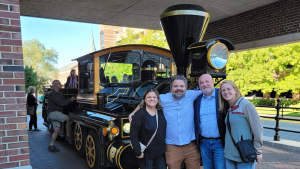 With four new schools officially joining the Big Ten in August, this year’s Academic Alliance gathering allowed the RO’s Aaron Apel, Will Lipske, Kelly Norton, and Heidi Tuescher-Gille to share the team’s successes – like our initial implementation and now our continued improvements to the Guide – with an even larger audience. More voices in the room also allowed the RO team to bring some new perspectives back to Madison.
One such lightbulb moment came during a tour of classroom spaces at host institution Purdue University. As UW–Madison undergoes a space use assessment, Lipske says hearing some of the ways other institutions list classrooms and which setups are the most popular proved beneficial.
“Knowing I’m going to be embarking right now on a deep dive of classrooms and space management as part of this class study at a campus level, and have this incidental where I was like, ‘This is how we talk about collaborative learning spaces, this is how technology has moved over time at our settings out there, hearing what the instructors and student are responding to – what they’re scheduling and not scheduling, what’s filling [and] not filling as far as demand,’ there was a fun happenstance of the fact this [project] is just getting started and I was at a Big Ten meeting where I had Iowa and Purdue and Minnesota… on that tour with me, just to walk around and A. physically see the stuff but B. the dialogues that came with that at the same time,” he explains.
The three-day event also serves as an opportunity to strengthen relationships among Big Ten peers and build new ones. The impromptu one-on-one conversations – which may not happen outside of such an event – help attendees refocus on what drives them in their work and often lead to insights that benefit students at UW–Madison and beyond, Lipske says.
“Those conversations, while we did Big Ten meetings via Zoom [during the pandemic], we can easily pick up a phone call, there’s something to be said about having that done in person where you can experience tone, where you can get immediate feedback and go back and forth as opposed to just having an email exchange,” he says. “The people matter, those connections are something that is good to have… reaffirmed or newly created and established.”
And while a call is easy to make, knowing who to call can be more challenging. Hearing directly from colleagues about the projects they are tackling at their institutions, Lipske says, eliminates the guesswork and allows for better sharing of best practices and lessons learned.
(Left to right) Heidi Tuescher-Gille, Will Lipske, Aaron Apel, and Kelly Norton attend a gathering of Big Ten registrars at Purdue University in October.