DiSC
Introduction
All DEM team members have access a tool called DiSC, which DEM uses as component of building a culture of belonging. DiSC is a tool for dialogue which provides insight into a person’s preferences and tendencies for interaction. By understanding these preferences and tendencies, DiSC can help team members Honor Identity and Promote Care & Collaboration, two of the pillars of the culture of belonging.
What is DiSC?
The DiSC assessment is a powerful tool designed to help you gain insights into your own preferences and those of others when it comes to interacting with people. By understanding these preferences, you can improve communication, foster better relationships, and create a more harmonious work environment.
Each individual’s style is represented within one of the four quadrants of the DiSC circle: Dominance, Influence, Steadiness, and Conscientiousness. These quadrants provide a framework for understanding different behavioral tendencies and how they manifest in various situations.
For more information about DiSC theory, click here.
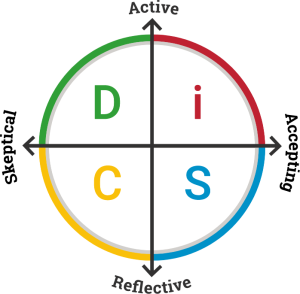
All About Assessments
The first step to determining your DiSC style is to take an assessment. If you are a new team member in DEM, Mike Hollander will connect with you. If you have taken a DiSC assessment in a previous position at UW–Madison, Mike will work with you to transfer your information to DEM.
A DiSC assessment takes about 30 minutes to complete. Once the assessment is complete, you will receive a report on your style and will be invited to join the Catalyst platform. DEM also offers regular trainings to help you understand your style better, while connecting with colleagues.
Learning & Talent Development also offers trainings.
Your DiSC style and profile
The platform where you can access your DiSC profile, as well as those of your colleagues, is called Catalyst. The Catalyst Home Page displays your style and provides quick access to three tools:
Get advice: In this area, you are able to see potential solutions to common workplace challenges.
Compare to a colleague: You are able to compare styles with colleagues to see where you both lie on the DiSC quadrants. You will also be able to see where your preferences are similar and where they are different. This will provide insight into how you and your colleagues might work together.
Build a group: This could be your everyday team or a project team you are a part of. You can create multiple groups and share them or keep them private. Creating a group will map each member of the group onto the DiSC quadrants and provide insights into the group dynamics that each person brings.
Your DiSC Style
This section provides an overview of your specific style, including your personalized map, showing where you lie within the DiSC quadrants.
A deep dive into your style provides insights into your preferences and can help you and your colleagues understand the way that you approach your work.
Your Colleagues
One of the most useful components of Catalyst is being able to see the styles of other team members across the entire division. This section lets you view profiles and filter them by style and department.
Your Groups
In this section, you can view the groups you have created. You can create as many groups that are useful to you. Groups that you create can be private for you or can be shared with other team members. The individuals in the group will be displayed on a group map and you can gain insights into how the group might function together.
Get Advice
Get advice provides four topic areas to get ideas for working with other DEM team members. The topics are Connecting, Collaborating, Getting buy-in, and Managing tension. Within each topic, you are able to select a specific team member and get advice tailored to both of you.
Workplace
This section gives you in-depth information about how your style approaches the workplace. Some of the information covered includes priorities, motivators, and stressors.
DiSC-ology
A section of broad information about DiSC such as the history and theory behind the model.
Additional information and FAQs
DiSC is a tool that can help you understand your preferences, and those of others, for interacting with other people.
While everyone has a primary style, it’s important to recognize that we all have the capacity to adapt and utilize traits from all areas of the DiSC circle. This flexibility allows us to respond more effectively to different circumstances and interact more successfully with a diverse range of people.
By leveraging the insights gained from the DiSC assessment, you can enhance your self-awareness, improve your interpersonal skills, and contribute to a more collaborative and productive workplace.
What DiSC is not
While the DiSC assessment is a valuable tool for understanding behavioral tendencies, it’s important to recognize its limitations.
DiSC is not predictive. Having a particular DiSC style does not mean that a person will always react in the same way or similarly to others with the same style. Human behavior is complex and influenced by various factors, including context, experiences, and individual differences. Therefore, DiSC should be used as a guide rather than a definitive predictor of behavior.
DiSC is not an excuse. It’s crucial to understand that DiSC styles should not be used to justify or excuse certain behaviors. For example, someone should not refuse a task or act in a specific way simply because it aligns with their DiSC style. Instead, the assessment should be used to foster self-awareness and personal growth, encouraging individuals to adapt and develop a more flexible approach to different situations.
By keeping these points in mind, you can use the DiSC assessment more effectively and responsibly, ensuring it serves as a tool for positive development rather than a limiting label.
DEM uses DiSC as a tool to promote dialogue. Understanding why someone acted in a certain way can help people accept the different perspectives and strengths of each team member. This helps contribute to a culture of belonging by making each person feel like their contributions are valued.
It is not used as a tool for recruitment, hiring, or performance evaluation.
Catalyst is the platform that hosts your DiSC profile and provides resources such as articles and insights.
DiSC’s focus on four personality traits is a simpler tool that emphasizes situational behavior. It is most useful for promoting collaboration and teamwork. DiSC is not intended for personal development or career guidance but rather understanding interpersonal relationships and behaviors.
Yes, there is research that supports the validity and reliability of DiSC. At the same time, there are limitations to what DiSC can tell us about an individual.
Everyone within DEM will be able to see your profile. This enables you and your colleagues to compare styles and consider how best to work together.
If you prefer to keep your profile private, you can turn “share with colleagues” off. To do so, navigate to account settings in your Catalyst profile. Sharing with colleagues will appear under privacy/communication.